Innovation Vision and Technical Capabilities - 2026-07-16
Preventing bacterial contamination during the long-term use and storage of orthokeratology (Ortho-K) lenses for vision correction has long been a critical focus in the medical field. Quantum NIL, in collaboration with the Institute of Biomedical Engineering at National Tsing Hua University (NTHU), has developed a novel biomimetic structure capable of resisting biofilm formation. The technology has completed preliminary verification and a patent application has been filed. With related research findings slated for official publication soon, this breakthrough is expected to provide a new solution for the effective preservation of medical devices.
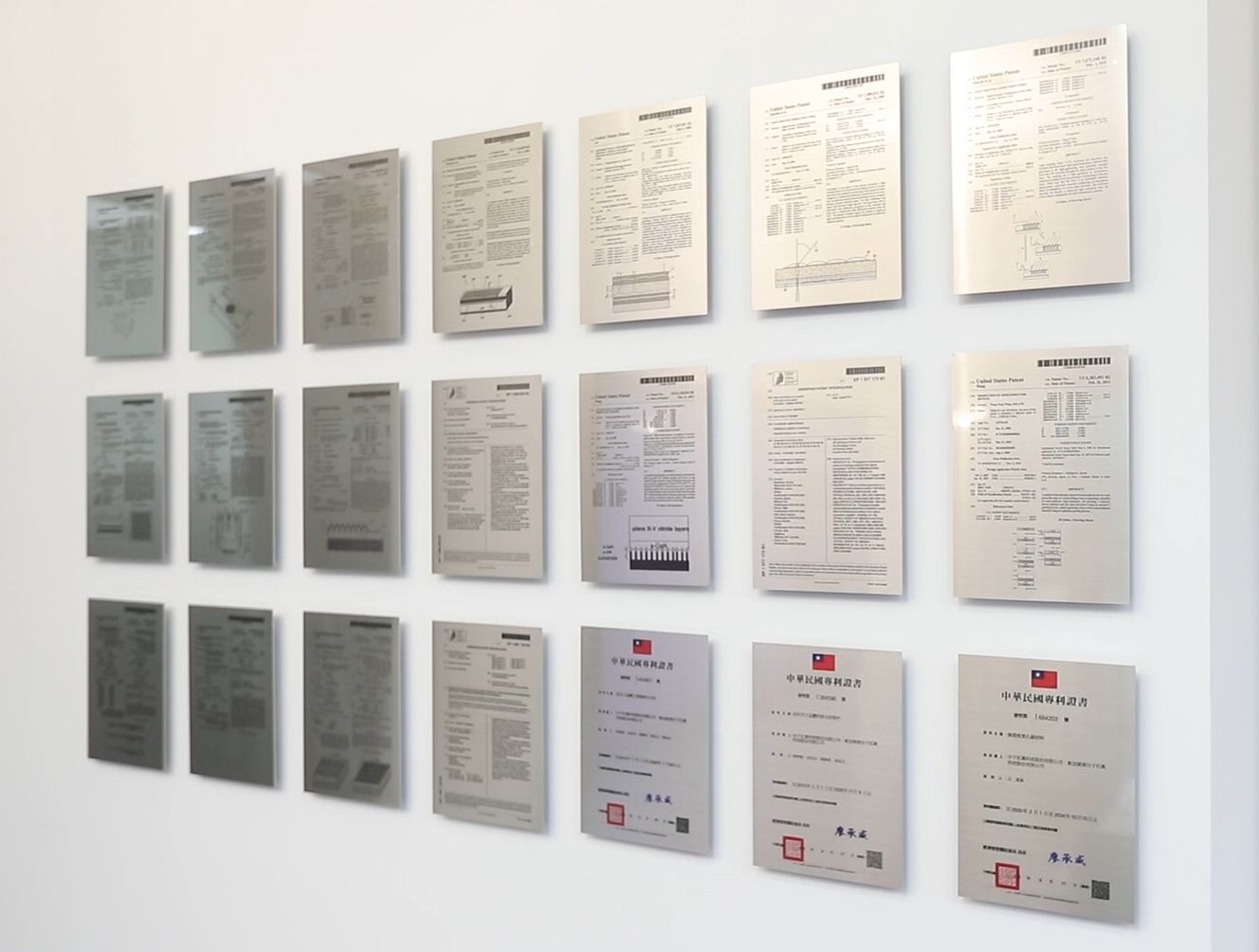
Deeply rooted in nanoimprint lithography (NIL) technology, Quantum NIL focuses on the precision manufacturing of wafer-level compound semiconductor materials, strategically expanding its applications in optical communications, biomedical diagnostics, meta-optics, and quantum technology. CEO Dr. Sean Lin stated that the team is currently conceptualizing the application of quantum interpretation to the development of next-generation biochips, aiming to bring new breakthroughs to cell diagnostics. Furthermore, the company is heavily investing in the development of nanofluidic technology for gene sequencing diagnostics. Core patents for these innovations are expected to be granted shortly, enabling the company to enter the international supply chain.
Dr. Sean Lin (right), CEO of Quantum NIL, engages in an in-depth discussion on quantum optics and AI applications with Dr. Amit Agrawal, Professor of Engineering at Trinity College, Cambridge. (Photo provided by Quantum NIL)
In late June, Sean Lin traveled to the UK to visit Trinity College at the University of Cambridge, meeting with engineering professor Dr. Amit Agrawal. The two engaged in in-depth exchanges on quantum optics and AI applications, sharing a mutual vision to accelerate the transition of quantum optics technology from research to commercialization. Leveraging its unique precision manufacturing capabilities for mass production, Quantum NIL assists academia in accelerating the commercialization of cutting-edge R&D results.
Dr. Sean Lin noted that quantum technology is widely regarded as the next "star industry" following AI. Driven by global policy support and market demand, its commercialization process is expected to accelerate continuously. While AI excels at analyzing existing data and achieving local optimization, quantum computing promises exponential leaps in computing efficiency for specific complex problems. The integration of both could unlock immense application value across various industries. In weather forecasting, for instance, utilizing quantum computing to process massive and highly complex data models has the potential to significantly enhance forecast efficiency and accuracy.
Dr. Sean Lin pointed out that the capital market's attention to the quantum technology sector continues to heat up. The successful NASDAQ listing of U.S. quantum computing company Quantinuum Inc. in early June garnered significant market attention, reflecting investors' positive expectations for the commercialization prospects of quantum technology. This indicates that quantum tech is rapidly accelerating from a long-term theoretical research phase toward actual industrial application.
During his UK trip, Sean Lin also visited optical communications giant Lumentum to investigate the development of 4- to 6-inch laser wafer technology and explore future directions for collaboration. He highlighted that micro-optical fibers and laser light sources are indispensable core components for AI data centers. As European and American manufacturers continue to strengthen their technology and supply chain layouts, the global optical communications industry is entering a phase of accelerated upgrades, and Taiwanese companies must continuously enhance their competitiveness to keep pace.
Dr. Sean Lin (left) visits optical communications giant Lumentum for a deep technical exchange with Dr. Xin Cao, Director of Component Engineering. (Credit: Quantum NIL)
Dr. Sean Lin has deep historical ties with UK-based IQE. During this revisit, he further learned that the cooperation between MA-COM and IQE has upgraded from a traditional customer relationship to a strategic partnership. Notably, IQE signed a long-term supply agreement with Tower Semiconductor in mid-June, aiming to further integrate supply chain resources and strengthen its strategic footprint in the global AI optical communications market.
Sean Lin (far right) visits IQE PLC. Pictured with Professor Wang-Nang Wang from the University of Bath (far left), Mark Mattingley, Communications Wafer Business Manager at IQE, and Andrew Joel, VP of Business at IQE. (Photo provided by Quantum NIL)
Looking back at the first half of this year, Quantum NIL has actively expanded its presence in the international market, successively attending the SelectUSA Investment Summit in the U.S. and participating in international seminars in Japan to continuously broaden overseas cooperation opportunities. In June, participating in the COMPUTEX InnoVEX 2026 startup competition, the company won the "Future Star Award" for its deep tech semiconductor project, demonstrating its robust technological innovation capabilities and market development potential.
In the second half of the year, Quantum NIL will maintain its strong momentum in international collaborations, further promoting its business model and enhancing brand visibility. To bolster its service delivery capabilities in key markets and advance its forward-looking application layouts, the company plans to officially launch its Series A fundraising in the near future.